
For years, Customer Relationship Management (CRM) systems have served as the central hub for customer data. They store interactions, track opportunities, manage service cases, and provide businesses with a clearer view of their customers.
But as customer expectations continue to rise and businesses operate across increasingly complex channels, traditional CRM systems are reaching a new point of evolution.
The future of CRM is no longer just about managing customer information.
It is about enabling intelligent systems that can understand context, make decisions, and take action.
This is where Agentic CRM comes in.
From System of Record to System of Action
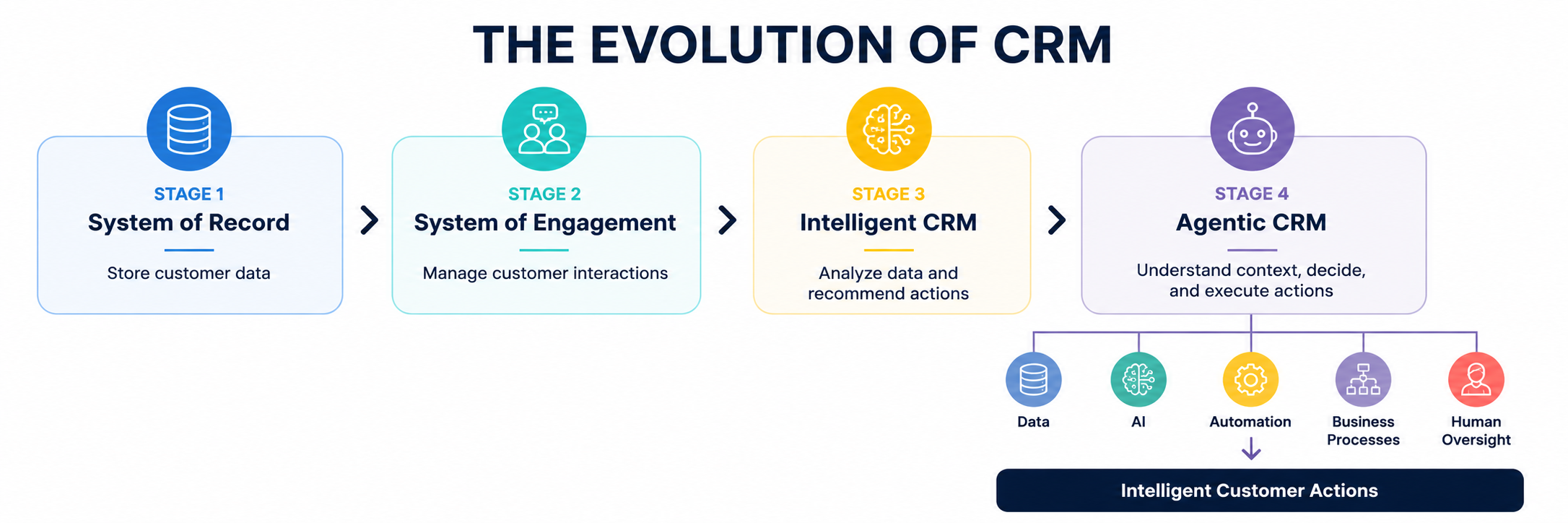
Traditional CRM was primarily designed as a system of record.
Sales teams recorded opportunities. Customer service agents logged cases. Marketing teams managed customer segments and campaigns.
Over time, CRM became more intelligent. Analytics, automation, machine learning, and AI-powered recommendations helped organizations gain deeper insights from their customer data.
However, in most cases, people still needed to interpret those insights and decide what to do next.
Agentic CRM represents the next stage.
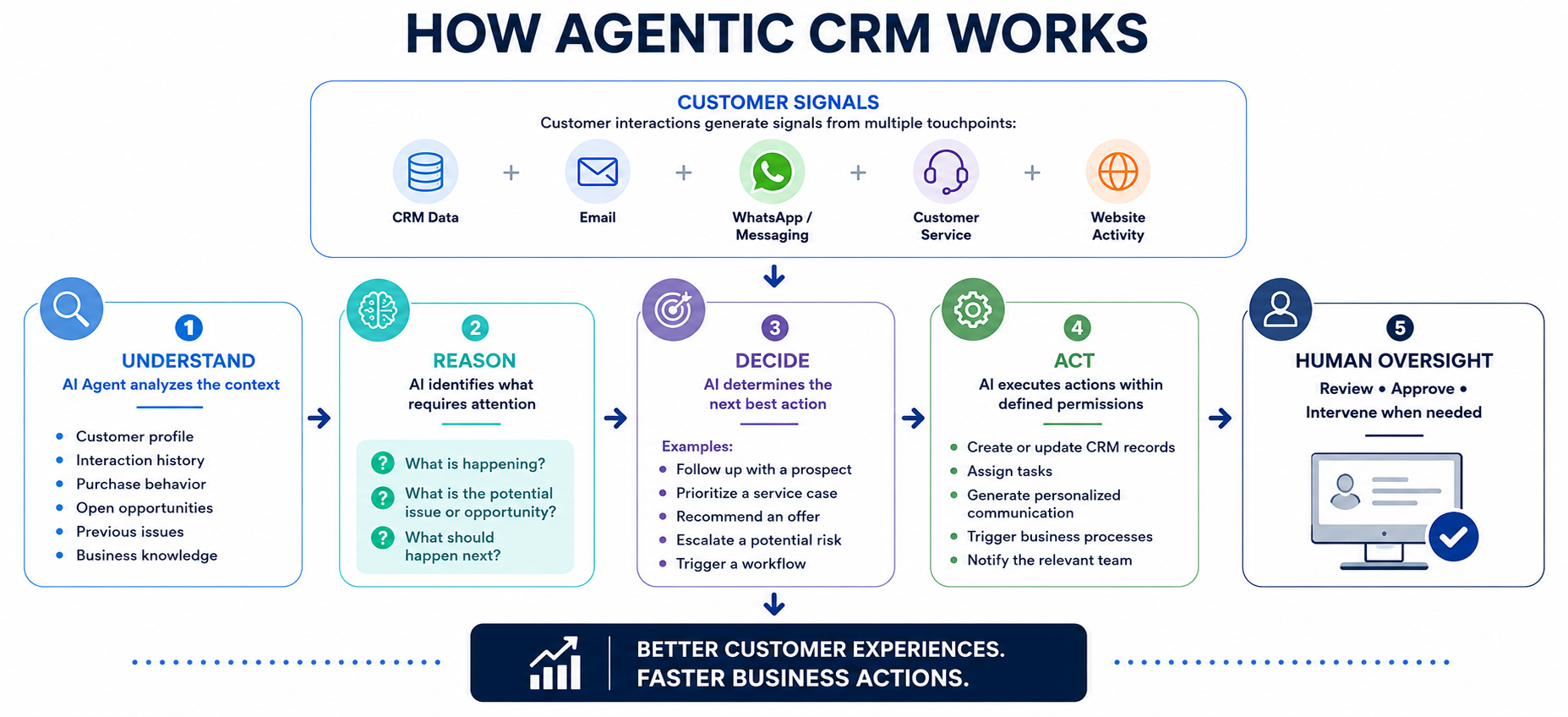
Instead of simply providing information or recommendations, AI agents can work toward specific business objectives by analyzing context, determining the next best action, and executing tasks within defined business rules and permissions.
In other words:
Traditional CRM stores what happened.
Intelligent CRM helps explain what is happening.
Agentic CRM can help determine and execute what should happen next.
This shift transforms CRM from a passive business application into a more active participant in customer operations.
What Is Agentic CRM?
Agentic CRM combines CRM data, artificial intelligence, automation, and AI agents to create systems capable of performing tasks with a higher level of autonomy.
Unlike conventional automation, which follows predefined workflows, AI agents can use context and available information to determine how to achieve a particular objective.
For example, an AI agent supporting a sales team could:
- Review customer interactions and account history.
- Identify changes in customer behavior.
- Detect opportunities that require follow-up.
- Recommend the next best action.
- Draft personalized communication.
- Update CRM records.
- Trigger relevant workflows.
- Escalate complex decisions to a human employee.
The goal is not to replace human teams.
The goal is to reduce repetitive operational work and enable employees to focus on activities that require strategic thinking, relationship building, creativity, and human judgment.
The Difference Between CRM Automation and Agentic CRM
Automation is already a familiar part of modern CRM.
For example:
When a customer submits a form → create a lead → assign it to a sales representative → send a notification.
This is a predefined workflow.
Agentic CRM operates differently.
Imagine an AI sales agent with the objective:
Identify high-potential opportunities that are at risk of going cold and help increase the likelihood of conversion.
To achieve this objective, the AI agent could evaluate multiple signals, including:
- Previous customer interactions.
- Email engagement.
- Opportunity stage.
- Historical buying behavior.
- Product interest.
- Sales activity.
- Time since the last interaction.
Based on the available context, it may determine which opportunities require attention, suggest the most relevant follow-up approach, prepare communication, and initiate appropriate actions based on the organization’s governance rules.
The key difference is that the system is not simply executing a single predetermined sequence.
It is using intelligence and context to work toward a defined outcome.
Why Agentic CRM Matters for Businesses
The growing interest in Agentic CRM is driven by a simple reality:
Businesses are generating more customer data than teams can realistically process.
Customer interactions now happen across websites, messaging platforms, emails, contact centers, social media, and physical channels.
The challenge is no longer simply collecting data.
The challenge is turning that data into timely and meaningful action.
Agentic CRM can help organizations address this challenge in several ways.
1. Faster Response to Customer Needs
AI agents can continuously monitor customer interactions and identify situations that require action.
For example, a service AI agent could detect recurring issues, prioritize urgent cases, gather relevant customer information, and assist human agents before they begin handling the request.
This can help organizations reduce response times while improving consistency.
2. More Intelligent Sales Execution
Sales teams often spend significant time updating CRM records, preparing follow-ups, searching for information, and managing administrative activities.
Agentic CRM can support these processes by helping sales representatives identify priorities, prepare next actions, summarize interactions, and maintain accurate customer data.
Instead of spending more time managing the CRM, teams can spend more time engaging with customers.
3. Personalized Customer Engagement at Scale
Personalization becomes increasingly difficult as customer volumes grow.
AI agents can analyze customer context and help businesses determine more relevant content, offers, communication timing, and engagement strategies.
This enables organizations to move beyond generic segmentation toward more contextual customer experiences.
4. Continuous Operational Intelligence
Traditional dashboards provide insights when someone reviews them.
Agentic systems can potentially monitor business signals continuously and respond when predefined conditions, risks, or opportunities are identified.
For example:
- A high-value customer has reduced engagement.
- An important opportunity has been inactive for too long.
- A service issue is affecting multiple customers.
- A customer may be ready for an upsell opportunity.
Instead of waiting for someone to discover the issue, an AI agent can bring attention to it or initiate an appropriate response.
The Building Blocks of an Agentic CRM
A successful Agentic CRM strategy requires more than simply adding a chatbot to an existing CRM platform.
It requires several connected capabilities.
1. Unified Customer Data
AI agents need access to accurate and relevant information.
Customer profiles, interactions, transactions, service history, communication data, and other business information should be connected across relevant systems.
Without reliable data, even the most advanced AI capabilities will produce unreliable outcomes.
2. AI and Contextual Intelligence
AI models need to understand the context surrounding a customer, interaction, or business process.
This may include customer history, organizational knowledge, business policies, product information, and previous actions.
Context is what enables AI to generate more relevant recommendations and decisions.
3. Business Process Automation
AI agents become more valuable when they can interact with actual business processes.
This may involve creating records, updating information, assigning tasks, triggering workflows, generating documents, or initiating customer communications.
The combination of AI and business process management allows organizations to move from insight toward execution.
4. Governance and Human Oversight
Autonomy should never mean a lack of control.
Organizations need clear rules regarding what AI agents can access, recommend, and execute.
Depending on the business process, certain actions may require human approval before execution.
An effective Agentic CRM should balance automation with governance, transparency, security, and accountability.
Where Can Agentic CRM Create the Greatest Impact?
Agentic CRM can support multiple customer-facing and operational functions.
Sales
An AI sales agent can help prioritize opportunities, prepare account summaries, recommend next steps, generate follow-up communication, and maintain CRM data.
Customer Service
AI agents can assist with case classification, knowledge retrieval, response generation, issue prioritization, and workflow execution.
Complex cases can be escalated to human agents with the necessary context already prepared.
Marketing
Agentic capabilities can help analyze customer behavior, identify audience opportunities, recommend personalized engagement, and coordinate actions across campaigns.
Customer Success
AI agents can monitor customer health signals, identify churn risks, detect expansion opportunities, and recommend proactive engagement.
The common principle is simple:
AI should not exist separately from customer operations.
Its real value comes from its ability to understand customer context and participate in the processes that shape customer experiences.
Agentic CRM Does Not Mean Removing Humans
One of the biggest misconceptions about AI agents is that they are designed to completely replace employees.
In reality, the strongest use cases often involve human-AI collaboration.
AI agents are particularly effective at handling:
- Repetitive tasks.
- Large volumes of information.
- Continuous monitoring.
- Pattern detection.
- Data processing.
- Process execution.
Humans remain essential for:
- Complex decision-making.
- Relationship building.
- Strategic judgment.
- Creativity.
- Negotiation.
- Empathy.
- Accountability.
The future of customer management is not necessarily human versus AI.
It is about designing better ways for humans and AI to work together.
How Should Businesses Prepare for Agentic CRM?
Organizations do not need to transform their entire customer operation overnight.
A more practical approach is to begin with high-value use cases.
Start by asking:
Where are teams spending significant time on repetitive activities?
Which customer processes require faster responses?
Where does valuable customer data exist without being converted into action?
Which decisions can be supported by AI while maintaining appropriate human oversight?
From there, organizations can identify specific use cases and gradually introduce AI capabilities into their CRM and customer processes.
The foundation remains critical.
Data quality, process design, system integration, governance, and clear business objectives should come before large-scale AI deployment.
The Future of CRM Is More Than Data Management
CRM has evolved significantly over the past few decades.
It started as a database for customer information.
It became a platform for sales, marketing, and service operations.
Then came automation, analytics, cloud technology, and AI-powered insights.
The next evolution is Agentic CRM.
CRM platforms are increasingly moving toward systems that do more than record customer activity.
They can help organizations understand context, identify opportunities, recommend actions, and participate directly in business processes.
For businesses, the question is no longer simply:
“How can we manage our customer data?”
The more important question is becoming:
“How can our customer data, processes, and AI work together to create better actions and better customer experiences?”
The organizations that answer this question successfully will be better positioned to build faster, more intelligent, and more responsive customer operations.
Discover the Future of Intelligent CRM
The journey toward Agentic CRM is not simply about adopting the latest AI technology.
It is about connecting business strategy, customer data, CRM, AI, and business processes into an operating model that creates measurable value.
At iSystem Asia, we help organizations explore and implement intelligent CRM capabilities designed around real business objectives—from CRM platforms and customer experience solutions to AI-powered automation and agentic workflows.
Discover the future of intelligent CRM. Talk to iSystem Asia today.