AI is no longer just a technology initiative. For organizations ready to compete in the next era of business, AI is becoming part of how the business operates, makes decisions, serves customers, and creates value.
But what does it actually mean to become an AI-native organization?
An AI-native organization is not simply a company that uses AI tools. It is an organization that designs its processes, systems, people, and decision-making around the capabilities of artificial intelligence from the beginning.
In other words, AI is not an add-on.
AI becomes part of the operating model.
An AI-native organization is a business that integrates artificial intelligence into its core operations, decision-making, customer experiences, and business processes.
Traditional organizations typically adopt technology to improve existing processes. An AI-native organization takes a different approach: it asks how processes, decisions, and customer experiences could be redesigned if AI were built into them from the start.
For example, instead of simply giving employees an AI chatbot, an AI-native organization may redesign its customer service operation so AI can:
- Understand customer requests
- Classify and prioritize cases
- Recommend the next best action
- Retrieve relevant knowledge
- Automate routine processes
- Escalate complex cases to human agents
- Learn from interactions and continuously improve
The difference is significant.
Using AI improves an existing process. Becoming AI-native changes how the process itself is designed.
AI Adoption vs. AI-Native: What’s the Difference?
Many organizations are already experimenting with AI.
Employees use generative AI to write emails. Marketing teams use AI to create content. Sales teams use AI to summarize meetings. Customer service teams use chatbots.
These are valuable use cases—but they do not necessarily make an organization AI-native.
The difference can be illustrated through three stages:
1. AI-Assisted
AI helps people perform individual tasks faster.
Example:
A sales representative uses AI to summarize a customer meeting.
2. AI-Enabled
AI becomes integrated into business applications and workflows.
Example:
After a sales meeting, AI automatically summarizes the conversation, updates the CRM, identifies customer needs, and recommends the next action.
3. AI-Native
AI becomes part of the organization’s operating model.
Example:
The entire sales process is designed around human + AI collaboration, where AI continuously analyzes customer signals, prioritizes opportunities, recommends actions, automates administrative work, and supports salespeople throughout the customer journey.
The goal is not simply to “use more AI.”
The goal is to rethink how the organization creates value with AI.
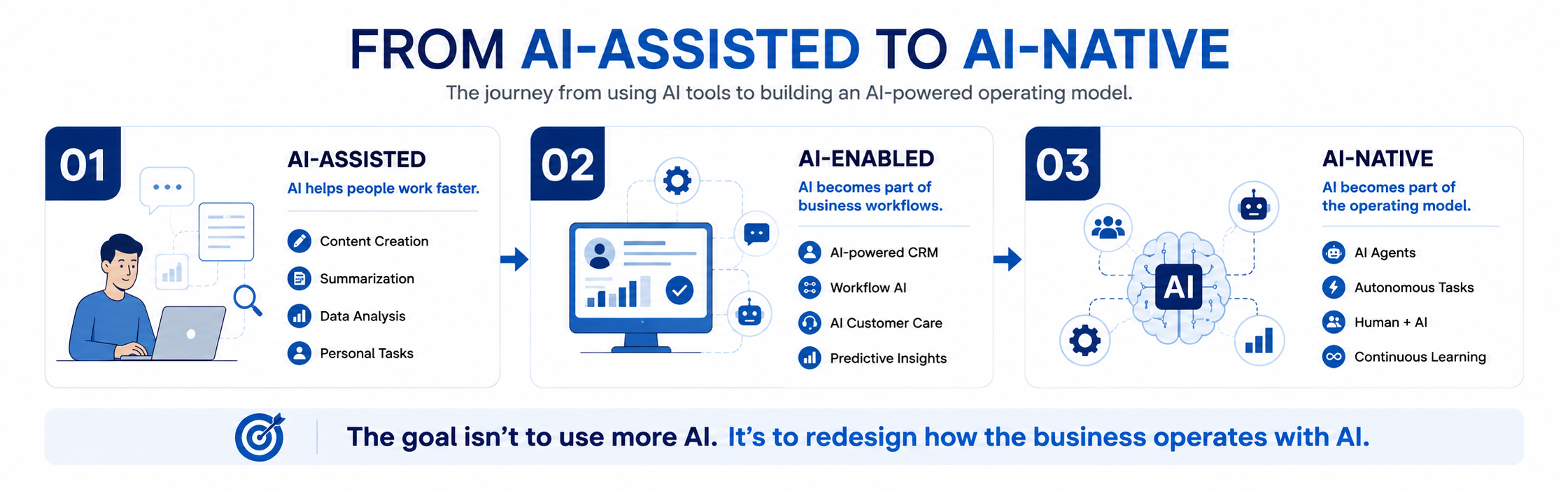
The journey isn’t about adopting more AI. It’s about redesigning how the business operates with AI.
5 Characteristics of an AI-Native Organization
Becoming AI-native requires more than implementing an AI platform. There are several characteristics that distinguish AI-native organizations from traditional businesses.
1. AI Is Embedded Into Business Processes
AI-native organizations don’t treat AI as an isolated application.
Instead, AI is embedded into the workflows employees already use.
For example, an AI-powered CRM can help sales teams identify high-value opportunities, recommend next actions, generate follow-up communications, and automate repetitive administrative tasks.
The result is not simply another software tool.
It is a more intelligent business process.
2. Data Becomes a Strategic Asset
AI is only as effective as the data it can access.
AI-native organizations therefore focus heavily on data quality, accessibility, governance, and integration.
Customer data, transaction data, operational data, employee knowledge, and business processes need to be connected so AI can understand the context behind business decisions.
This is why organizations pursuing AI transformation often need to address data silos before they can unlock the full value of AI.
Connected data creates the foundation for intelligent decisions.
3. Humans and AI Work Together
AI-native does not mean human-free.
In fact, the most effective AI-native organizations understand where AI should act independently and where human judgment remains essential.
AI can handle repetitive tasks, analyze large amounts of information, identify patterns, and recommend actions.
People provide context, judgment, creativity, empathy, and accountability.
The future of work is therefore less about AI replacing people and more about people working differently with AI.
4. AI Can Execute, Not Just Recommend
One of the biggest shifts in enterprise AI is the move from AI that simply generates information to AI that can take action.
For example, an AI system could:
- Identify a customer issue.
- Determine the appropriate response.
- Retrieve relevant company knowledge.
- Update the CRM.
- Trigger a workflow.
- Notify the appropriate employee.
- Escalate the case when human intervention is required.
This is where AI begins moving from a copilot to an active participant in business processes.
5. Continuous Improvement Becomes Part of the Operating Model
Traditional systems often operate according to predefined rules.
AI-native systems can continuously analyze new data, interactions, and outcomes to improve recommendations and processes.
This creates a feedback loop:
Data → AI → Action → Outcome → Learning → Better Action
The organization becomes increasingly capable of learning from its own operations.
Why Should Businesses Become AI-Native?
The business case for becoming AI-native goes beyond productivity.
When AI is embedded across the organization, businesses can potentially improve several dimensions simultaneously.
Faster Decision-Making
AI can analyze large volumes of information and surface relevant insights faster, helping executives and teams make more informed decisions.
Higher Employee Productivity
AI can automate repetitive administrative work and allow employees to focus on activities that require judgment, creativity, and human interaction.
Better Customer Experience
AI can help organizations deliver faster, more personalized, and more consistent customer experiences across multiple channels.
More Efficient Operations
Intelligent automation can reduce manual processes, improve workflows, and help organizations allocate resources more effectively.
Scalable Growth
AI can help organizations handle increasing volumes of customers, transactions, and operational activities without requiring every process to scale linearly with headcount.
What Does an AI-Native Architecture Look Like?
An AI-native organization requires more than an AI model.
It requires an ecosystem that connects people, data, applications, AI, and business processes.
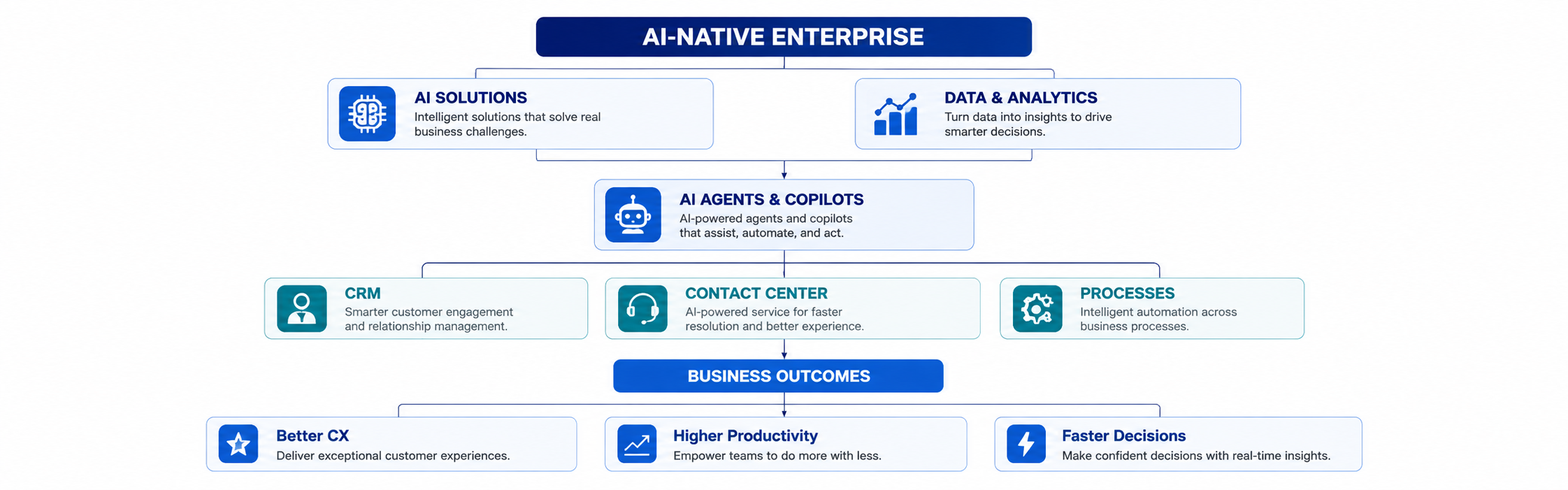
The journey isn’t about adopting more AI. It’s about redesigning how the business operates with AI.
How Can a Company Start Becoming AI-Native?
Becoming AI-native doesn’t require transforming the entire organization overnight.
A more practical approach is to start with high-value business problems.
Step 1: Identify High-Impact Use Cases
Look for processes that are:
- Highly repetitive
- Data-intensive
- Time-consuming
- Customer-facing
- Dependent on large amounts of knowledge
- Currently creating operational bottlenecks
Examples include customer service, sales operations, employee knowledge management, reporting, and process automation.
Step 2: Connect the Data
Identify where the required information currently lives.
CRM systems, business applications, databases, documents, communication channels, and operational systems often operate in silos.
AI needs access to relevant and trusted information to produce useful outcomes.
Step 3: Integrate AI Into Existing Workflows
Rather than creating another standalone AI application, embed AI into the systems employees already use.
For example:
CRM + AI → Intelligent Sales
Contact Center + AI → Intelligent Customer Service
Business Processes + AI → Intelligent Automation
Enterprise Knowledge + AI → Intelligent Employee Assistance
Step 4: Establish Governance
AI adoption must be supported by appropriate governance.
Organizations should consider:
- Data privacy
- Security
- Access control
- AI transparency
- Human oversight
- Model performance
- Regulatory requirements
Trust is essential if AI is going to become part of critical business processes.
Step 5: Measure Business Outcomes
AI transformation should not be measured only by the number of AI tools deployed.
Instead, measure outcomes such as:
- Reduced processing time
- Improved conversion rates
- Faster response times
- Higher customer satisfaction
- Lower operational costs
- Increased employee productivity
- Improved decision quality
The real question is not “How much AI are we using?”
The real question is “What business outcomes is AI creating?”
The Future Belongs to AI-Native Businesses
AI is rapidly moving beyond experimentation.
Organizations are beginning to rethink how they sell, serve customers, manage operations, make decisions, and create products.
The companies that gain the most value from AI may not necessarily be those that adopt the most AI tools.
They will be the organizations that successfully redesign the way their business operates around intelligence.
An AI-native organization connects:
People + Data + AI + Processes + Business Applications
into a system that can continuously learn, adapt, and act.
That is the real opportunity behind AI transformation.
How iSystem Asia Can Help
Becoming AI-native is not simply a technology implementation project.
It requires a clear understanding of business processes, customer journeys, data, technology architecture, and organizational priorities.
At iSystem Asia, we help organizations explore and implement practical AI-driven solutions across their business—from AI-native platforms and Agentic CRM to AI-powered customer service, intelligent process automation, and data & analytics.
The goal is simple:
Turn AI from an experiment into a business capability.
Whether you’re starting your AI journey or looking to scale existing AI initiatives, the first step is identifying where AI can create measurable business value.
Ready to explore your AI-native journey?
Talk to iSystem Asia and discover where AI can create the biggest impact for your organization.