
Customer experience is no longer a function to optimize. It is a business capability that can shape loyalty, revenue, and long-term growth.
For executives, the challenge is rarely about creating one great customer interaction. The bigger challenge is ensuring that every interaction—across Marketing, Sales, Service, Operations, digital channels, and physical channels—works together as part of one coherent experience.
Because customers do not experience an organization through its departments.
They experience one brand.
A customer may discover a brand through a digital campaign, engage with a sales representative, receive support through a contact center, make a purchase through a digital channel, and continue the relationship through after-sales service.
Each interaction may happen in a different channel, handled by a different team, and powered by a different system.
But to the customer, it is all one experience.
That is why great customer experience is not created by optimizing individual touchpoints in isolation. It is built by connecting them into one consistent, intelligent, and customer-centric journey.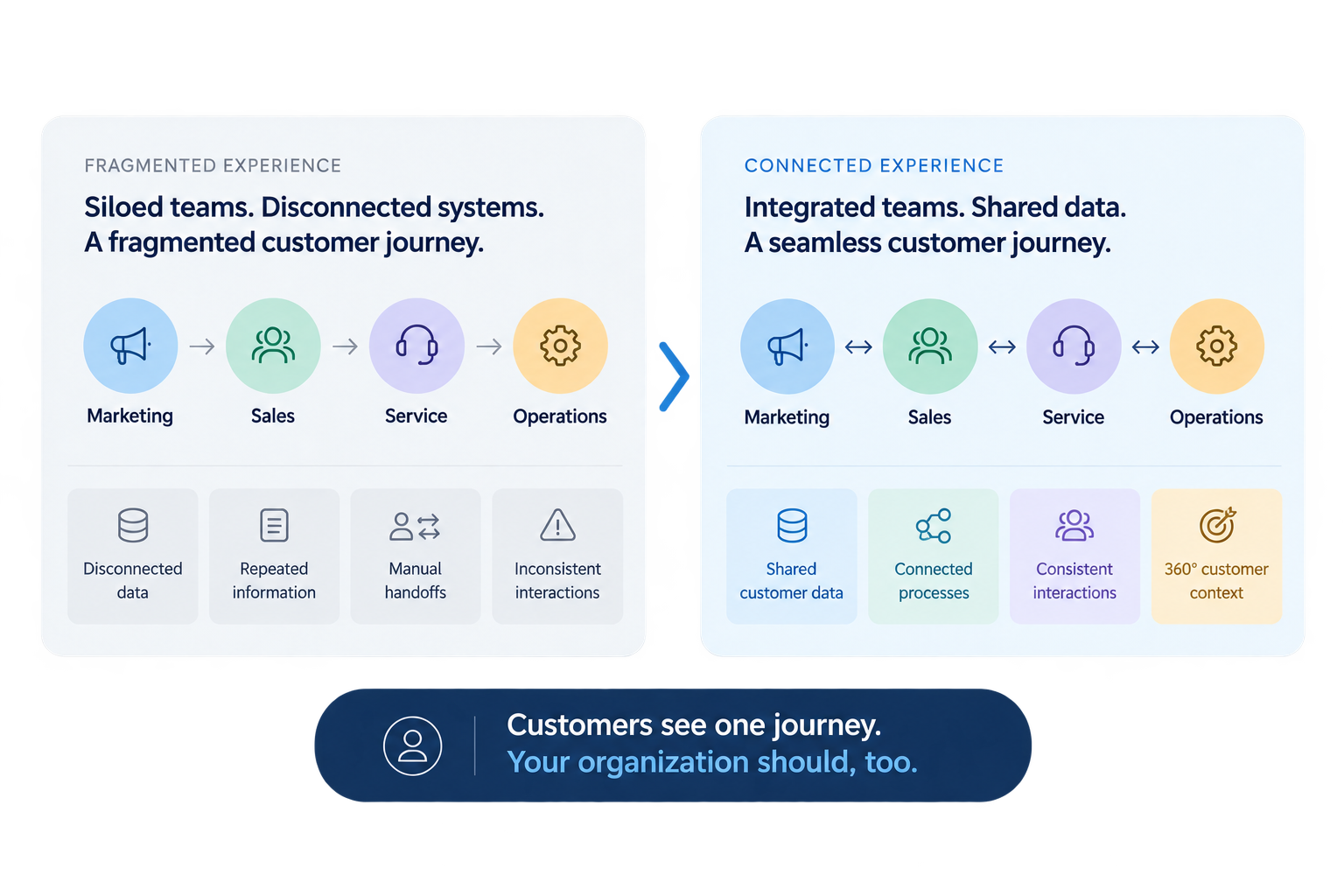
Customers See One Journey. Organizations Often See Many Touchpoints.
Inside an organization, customer interactions are typically divided across functions.
Marketing manages campaigns and leads.
Sales manages opportunities and accounts.
Customer service manages inquiries and cases.
Operations manages fulfillment.
IT manages the systems connecting them.
This structure makes sense organizationally. But it can create fragmented customer experiences.
A customer who has already provided their information to Marketing may be asked for the same information again by Sales. A service agent may not have visibility into the customer’s purchase history. A sales representative may not know about an unresolved service issue.
The problem is not necessarily the lack of technology.
The challenge is the lack of connection.
When data, processes, and teams operate in silos, the customer experiences the gaps between them.
Every Touchpoint Shapes the Customer’s Perception
Customer experience is shaped by hundreds of moments, both big and small.
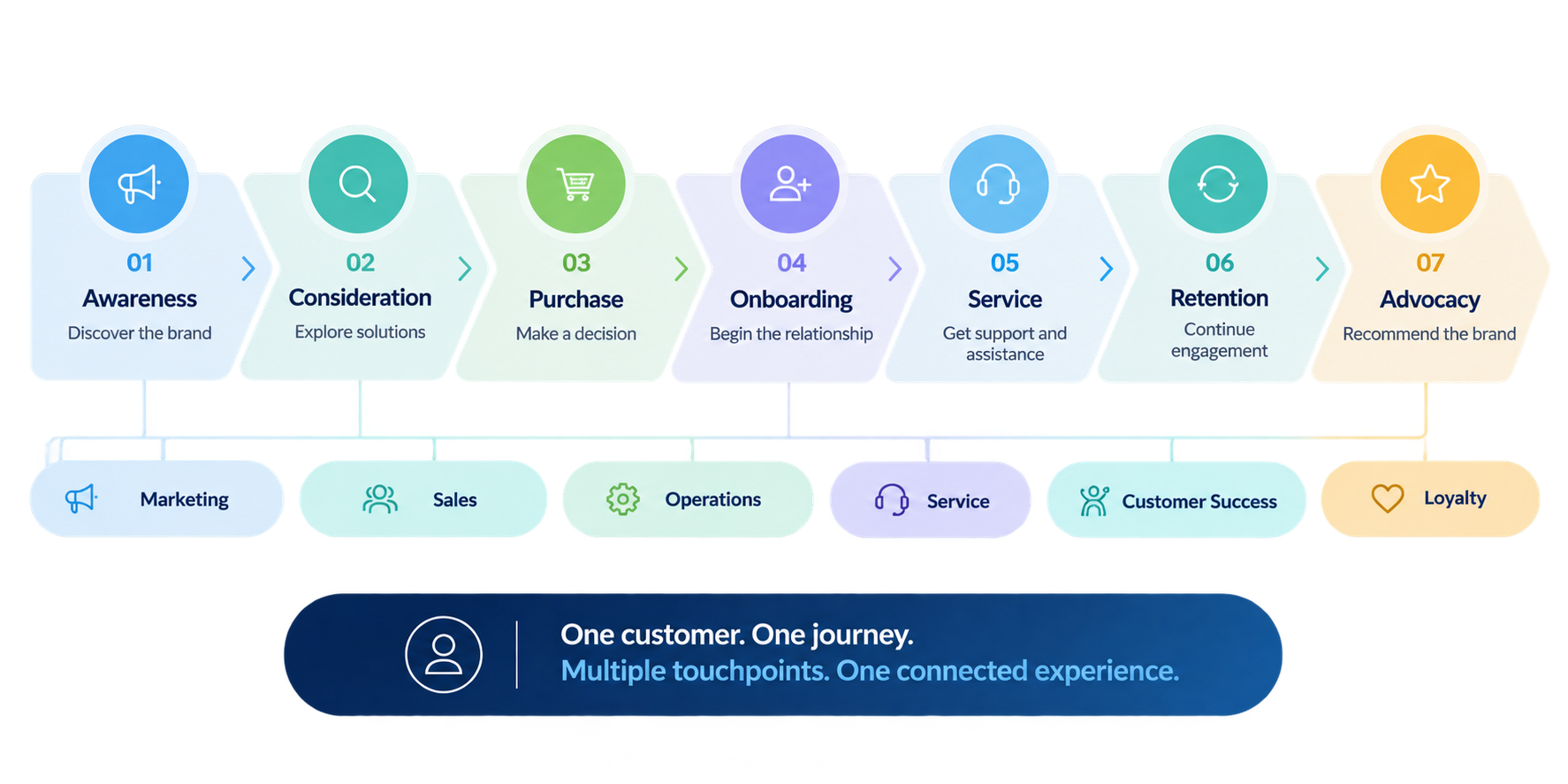
Consider a typical customer journey:
Awareness → Consideration → Purchase → Onboarding → Service → Retention → Advocacy
At every stage, customers form an impression of the organization.
Was the information relevant?
Was the interaction personalized?
Was the response fast enough?
Did the organization understand their needs?
Did they have to repeat themselves?
When these experiences are connected, customers experience continuity.
When they are disconnected, friction becomes visible.
And friction accumulates.
Consistency Matters More Than Individual Moments
A great marketing campaign cannot compensate for a frustrating service experience.
A highly responsive sales team cannot completely overcome a complicated onboarding process.
Likewise, an efficient contact center cannot deliver a truly connected experience if agents lack access to relevant customer information.
Customer experience should therefore be viewed as an ecosystem rather than a collection of isolated activities.
The objective is not simply to make every touchpoint excellent on its own.
It is to make the entire journey feel seamless.
That requires organizations to connect three critical dimensions.
Three Foundations of a Connected Customer Experience
1. Customer Data
Customer information should be accessible across relevant functions and channels.
A unified view helps teams understand who the customer is, what they have done, what they need, and where they are in their journey.
Instead of asking customers to repeatedly explain their history, organizations can use existing context to make every interaction more relevant.
2. Processes and Workflows
Connected data alone does not create a connected experience.
The processes behind each interaction must also work together.
When a lead becomes an opportunity, when an opportunity becomes a customer, or when a service case requires escalation, information and actions should move seamlessly between teams.
Automation can reduce manual handoffs, eliminate unnecessary steps, and help organizations respond at the right moment.
3. People and Technology
Technology should enable people to deliver better experiences—not create another layer of complexity.
Sales teams need the right customer context. Service teams need visibility into previous interactions. Marketing teams need insights that help them engage customers more meaningfully.
When people, processes, and technology work together, organizations can move from reactive interactions toward proactive customer engagement.
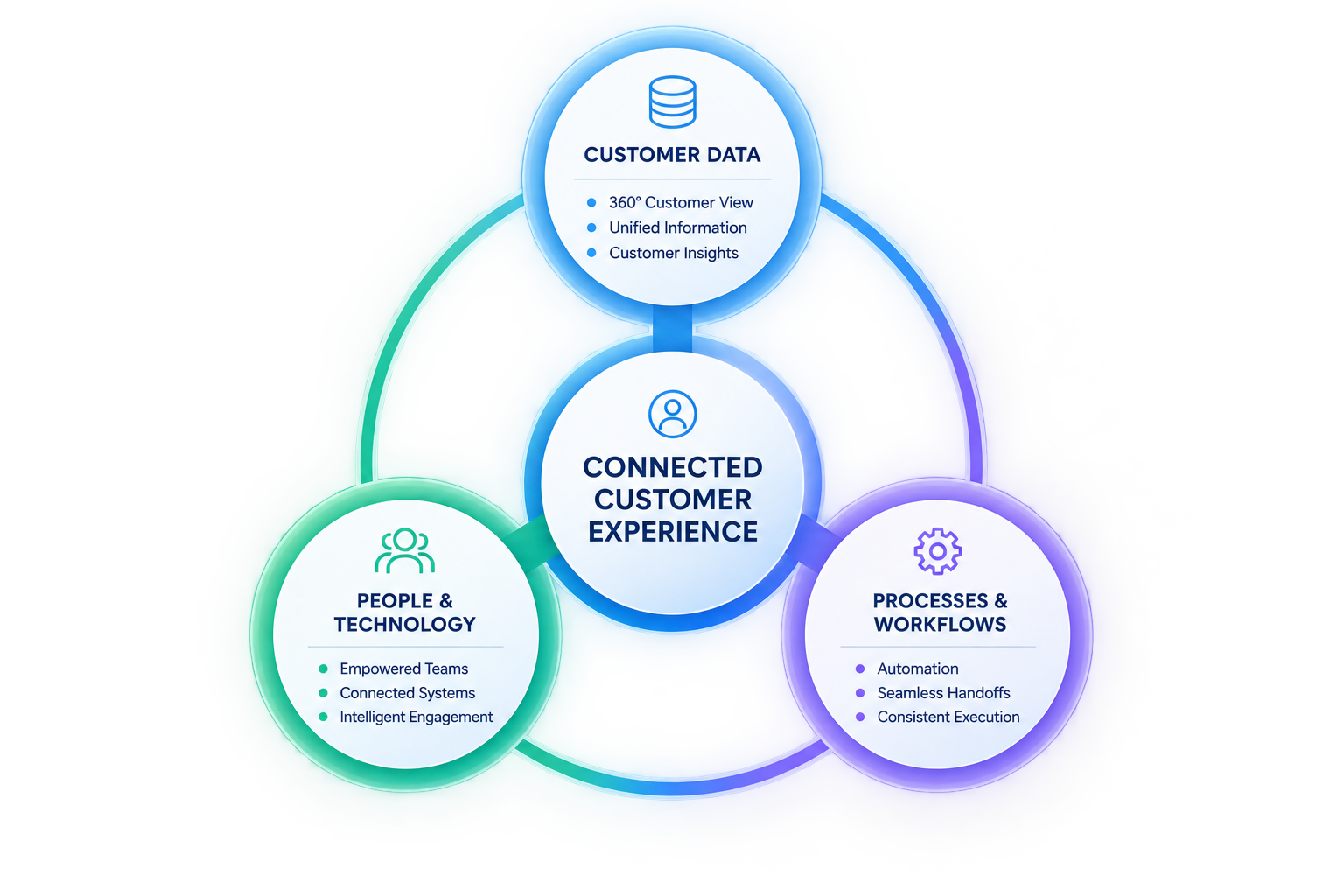
Data + Process + People & Technology = Connected Customer Experience
From Fragmented Touchpoints to Connected Experiences
Building a connected customer experience requires organizations to look beyond individual systems and departments.
The real question is not: “How can we improve this touchpoint?”
It is: “How does this touchpoint connect to everything that comes before and after it?”
This shift in perspective changes how organizations approach Customer Experience.
CRM is no longer simply a database for sales teams.
Contact centers are no longer just channels for resolving complaints.
Data and analytics are no longer limited to reporting.
AI is no longer simply an automation tool.
Together, these capabilities can become part of an integrated customer experience ecosystem—one that helps organizations understand customers, anticipate needs, coordinate interactions, and continuously improve the journey.
Designing CX Around the Customer, Not the Organization
Many organizations are structured around internal functions.
Customers, however, do not experience those organizational boundaries.
They simply experience the brand.
That is why customer journey design should start from the customer’s perspective.
Map the journey.
Identify every interaction.
Understand where information is lost.
Find where customers experience friction.
Connect the systems and teams behind those moments.
Then use data and technology to continuously improve the experience.
This is where Customer Experience Strategy becomes more than a technology initiative.
It becomes a business transformation discipline.
The Future of Customer Experience Is Connected
As customer expectations continue to evolve, organizations will need more than individual digital channels or isolated automation initiatives.
They need a connected foundation that allows every interaction to contribute to a broader understanding of the customer.
The organizations that create this connection can move beyond simply responding to customers.
They can anticipate.
They can personalize.
They can coordinate.
And they can create experiences that feel consistent across the entire customer journey.
Because ultimately, great customer experience is not built at one touchpoint.
It is built across every touchpoint.
Build a Customer Experience That Connects
At iSystem Asia, we help organizations connect customer strategy, technology, data, processes, and people to create more meaningful and consistent customer experiences.
From CRM and Customer 360 to Contact Center, Data & Analytics, AI, and Business Process Management, we look at CX as an interconnected business ecosystem—not a collection of separate initiatives.
The goal is simple:
Make every customer interaction part of one connected experience.
Design a connected customer experience, now!
Talk to iSystem Asia and explore how your organization can build a more connected, intelligent, and customer-centric experience across every touchpoint.