
In today’s business environment, speed matters.
Companies need to respond quickly to changing customer expectations, supply chain disruptions, market opportunities, and competitive pressures. Yet many organizations still struggle to make fast, confident decisions—not because they lack data, but because their data is scattered across different systems, departments, and applications.
These disconnected pockets of information are known as data silos.
While data silos may develop naturally as a business grows, they can eventually become a significant barrier to efficiency, collaboration, and decision-making. When teams cannot easily access the same information, even simple decisions can require multiple reports, spreadsheets, emails, and manual reconciliations.
The result is a business that has plenty of data but cannot always use it when it matters most.
What Are Data Silos?
A data silo is a collection of information that is accessible to one department, system, or business function but is not easily shared with the rest of the organization.
For example, sales teams may manage customer information in a CRM platform, finance teams may rely on an accounting or ERP system, operations teams may maintain separate inventory records, while other departments continue working with spreadsheets.
Each system may perform its individual role effectively. The problem appears when information needs to move between them.
If customer, financial, inventory, operational, and supply chain data are not connected, employees may spend significant time gathering and reconciling information before they can act on it.
As businesses become larger and more complex, these gaps can become increasingly difficult to manage.
How Data Silos Slow Businesses Down
Data silos do more than create inconvenience. They introduce friction into everyday business processes.
1. Decisions Take Longer
Business leaders need accurate information to make decisions. But when information is distributed across multiple systems, obtaining a complete picture can take time.
A manager trying to understand sales performance, for example, might need data from sales, inventory, finance, and operations. If each department maintains separate information, teams first need to collect, compare, and validate the numbers.
By the time the analysis is complete, the situation may already have changed.
Connected business data can reduce this delay by giving decision-makers access to more consistent and timely information across business functions.
2. Teams Work With Different Versions of the Truth
When departments maintain separate databases, reports, or spreadsheets, inconsistencies can quickly appear.
Sales may have one set of customer information. Finance may have another. Operations may be working with different inventory figures.
When teams cannot determine which information is current, employees spend valuable time verifying data instead of acting on it.
This also increases the risk of decisions being made based on incomplete or outdated information.
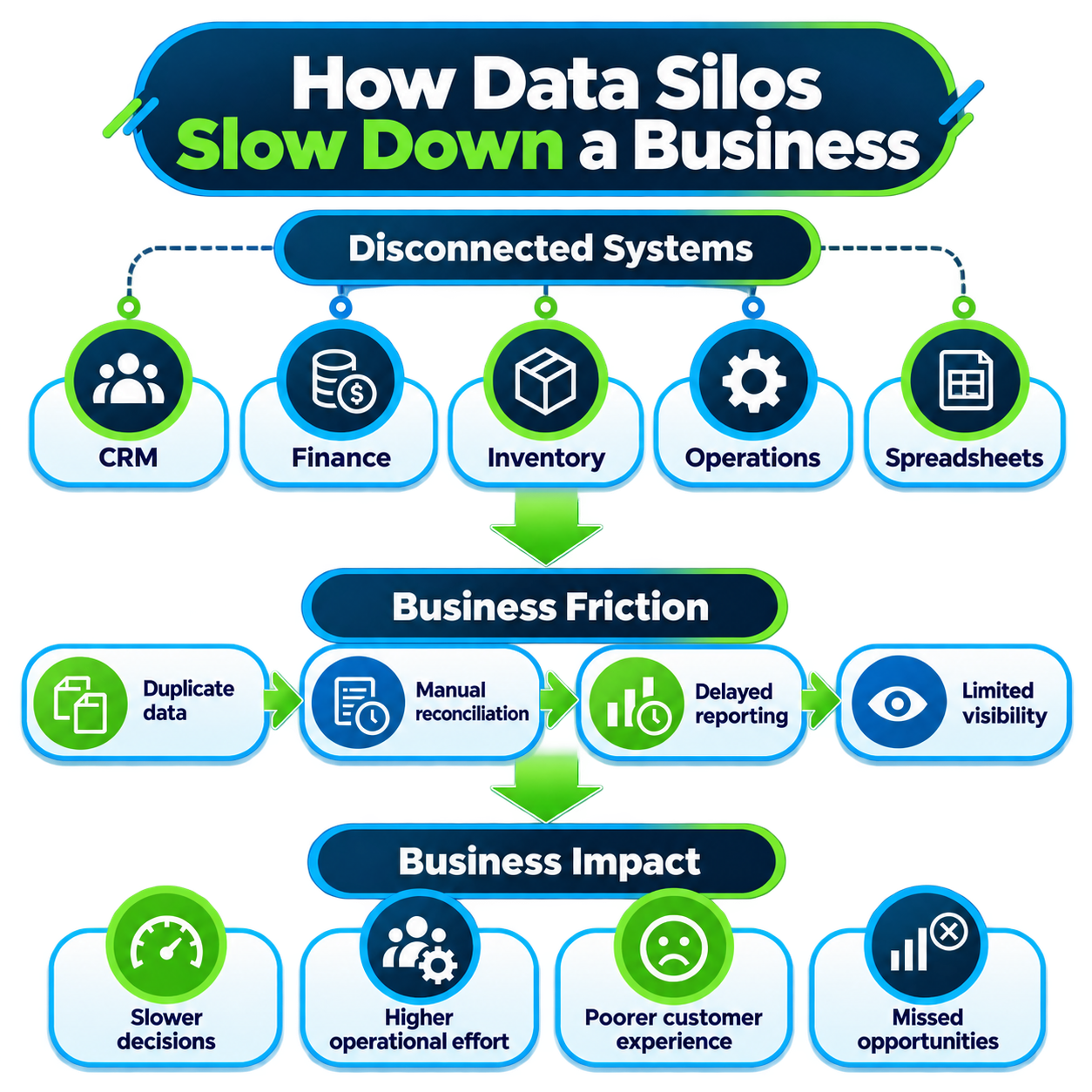
3. Manual Work Increases
Disconnected systems often require employees to become the bridge between different sources of information.
Data may need to be exported from one system, reorganized in a spreadsheet, checked against another report, and then manually entered somewhere else.
These processes are not only time-consuming. They can also introduce human error.
As transaction volumes grow, manual processes become increasingly difficult to scale. Employees spend more time maintaining information instead of focusing on higher-value activities such as analysis, customer service, innovation, and business improvement.
4. Collaboration Becomes More Difficult
Modern businesses rely on collaboration across departments.
A customer order may involve sales, finance, inventory, logistics, and customer service. If each department works from isolated information, employees may not have enough context to understand what is happening across the entire process.
For example, a sales representative may confirm an order without having real-time visibility into inventory. Customer service may not immediately see the status of fulfillment. Finance may receive transaction information only after another team manually submits it.
Connected data helps departments operate with shared context, reducing unnecessary back-and-forth communication.
5. Customer Experiences Become Fragmented
Customers see one company—not separate departments.
They expect organizations to understand their previous interactions, orders, requests, and preferences regardless of which team they contact.
Data silos make delivering that experience more difficult.
If customer information is spread across different platforms, employees may lack the complete context required to respond quickly. Customers may need to repeat information, wait while employees check another system, or receive inconsistent answers from different departments.
Connecting customer and operational data can give employees a clearer picture of each interaction and help create a more consistent customer experience.
6. Business Growth Creates More Complexity
Data silos may be manageable when a company is small.
However, as the organization adds new departments, locations, products, customers, and technology platforms, the number of disconnected data sources can grow rapidly.
Processes that once relied on a few spreadsheets may eventually involve multiple applications and large volumes of information.
Without an integrated approach to business data, complexity grows alongside the company.
This can make scaling operations increasingly difficult.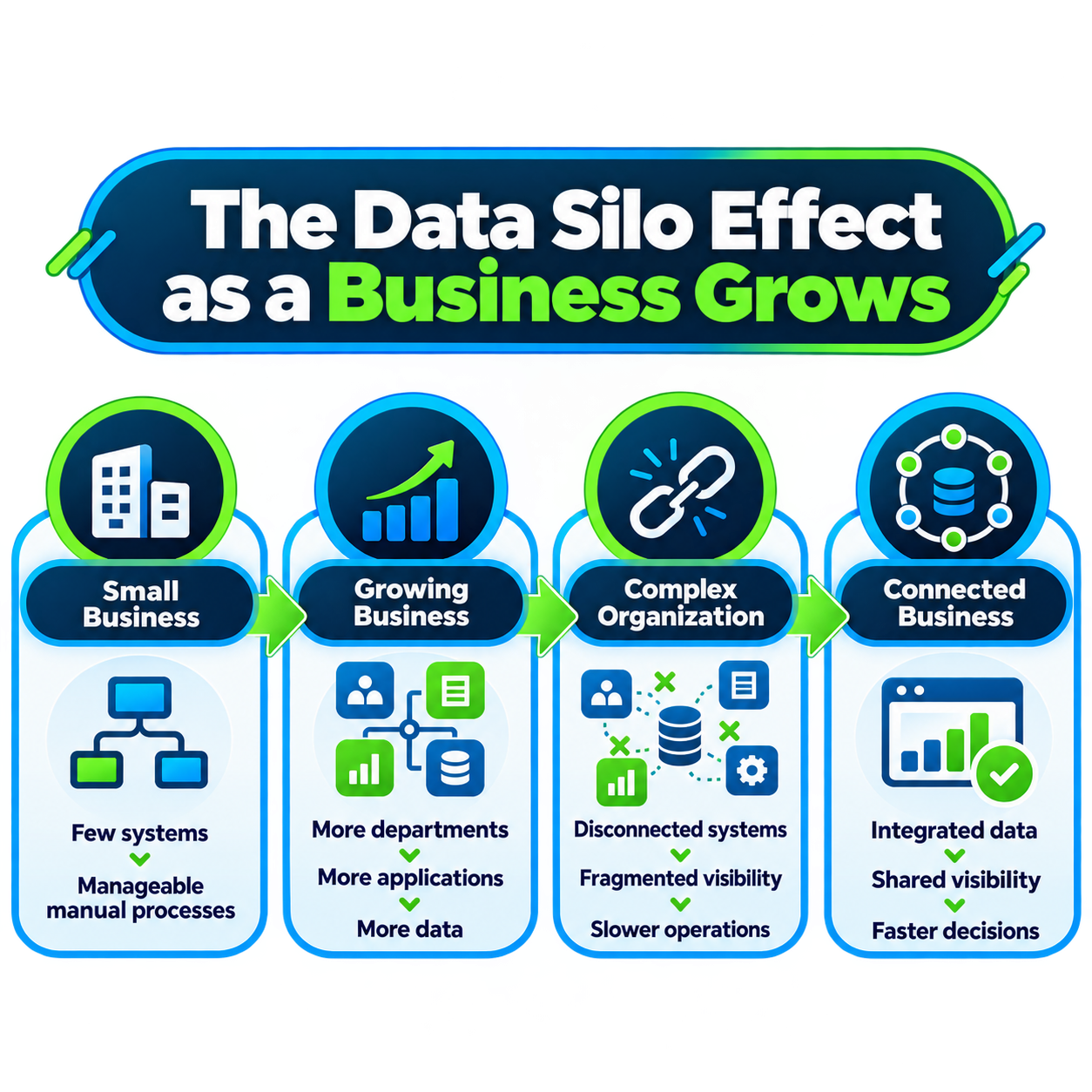
The Hidden Cost of Disconnected Data
The cost of data silos is not always visible on a financial statement.
It often appears through hundreds of small inefficiencies across the organization: employees searching for information, teams reconciling reports, managers waiting for updates, duplicated data entry, delayed approvals, and repeated customer inquiries.
Individually, these activities may seem minor.
Combined across multiple departments and thousands of transactions, however, they can consume significant time and resources.
More importantly, disconnected data can limit an organization’s ability to respond quickly to change.
When leaders cannot easily understand what is happening across the business, identifying problems and opportunities becomes more difficult.
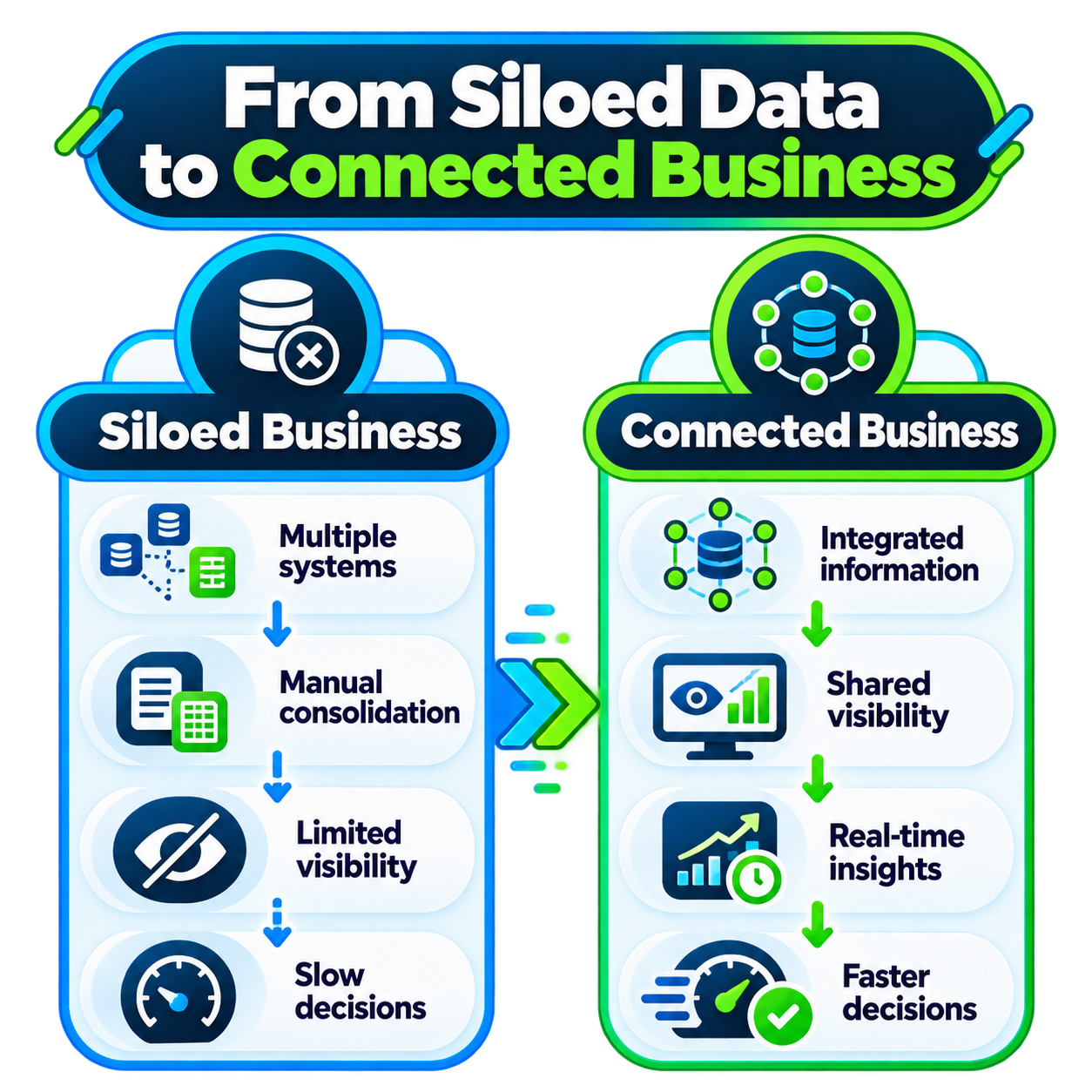
From Data Silos to Connected Business Data
Breaking down data silos does not necessarily mean replacing every system an organization already uses.
The broader goal is to create an environment where relevant information can move across business functions and provide employees with a consistent view of operations.
A connected data environment can help organizations:
- Reduce duplicate data entry and manual reconciliation.
- Improve visibility across departments.
- Provide more consistent reporting.
- Give employees faster access to relevant information.
- Improve collaboration between business functions.
- Support automation across end-to-end workflows.
- Enable faster and more informed decision-making.
The key difference is not simply having more data.
It is making the data the organization already has easier to access, understand, and use.
Connected Data Creates the Foundation for Faster Decisions
Technology alone does not make a business faster.
A company becomes faster when employees can obtain the information they need without unnecessary friction.
When finance, sales, operations, inventory, and customer information can work together, teams spend less time searching for answers and more time acting on them.
Leaders gain better visibility into business performance. Employees can coordinate processes more effectively. Customers receive faster and more consistent service.
Most importantly, the organization becomes better equipped to respond as conditions change.
Turn Business Data Into Business Momentum
Businesses already generate valuable information every day across customers, transactions, finance, inventory, operations, and other functions.
The challenge is ensuring that information does not remain trapped inside individual systems.
Creating stronger connections between business data can reduce operational friction, improve visibility, and give teams the information they need to move with greater speed and confidence.
Unlock the value of connected business data.